Automation Without Chaos: Why Public Sector IT Needs Strategy
Automation Without Chaos: Why Public Sector IT Needs Strategy — Not Scripts
Public Sector IT teams are under pressure to do more with less.
- Fewer staff.
- More systems.
- Higher security expectations.
- Tighter compliance oversight.
Automation often enters the conversation as the obvious solution.
But automation done casually, especially in distributed environments like higher education, can create as many problems as it solves.
The real value of automation isn’t speed, It’s control.
Automation Is a Business Decision
When most organizations think about automation, they think about reducing manual effort, that’s part of it.
But the real business value shows up elsewhere:
- Reduced configuration drift
- Faster incident recovery
- Standardized security posture
- Consistent compliance reporting
- Lower operational risk
Configuration drift, in particular, has become a well-documented risk across enterprise environments, especially as hybrid infrastructure expands (see research from sources like Gartner or industry summaries such as TechTarget’s overview of configuration drift).
The DIY Trap (Especially in Education)
Higher education institutions and decentralized agencies often adopt automation organically.
A systems engineer writes a few scripts, another team builds their own tool chain, and different departments automate differently.
At first, it feels innovative, but over time, it becomes fragmented.
Common pitfalls include:
- Script sprawl with no documentation
- Automation dependent on one or two individuals
- Inconsistent security baselines
- No version control or change management
- Limited audit visibility
Even industry commentators note common “pitfalls to avoid in government automation,” such as siloed automation efforts and inconsistent standards, which directly align with the risks that script-sprawl creates.
DIY automation can scale technically, but rarely scales operationally. Remember, when key personnel leave, the automation leaves with them.
What Structured Automation Looks Like
Effective automation in Public Sector environments should provide:
- Centralized governance
- Role-based access controls
- Audit trails
- Standardized playbooks
- Integration with existing ITSM workflows
This isn’t about complexity, It’s about maturity.
Organizations that move beyond ad hoc scripting often adopt platforms that introduce orchestration, governance, and lifecycle control.
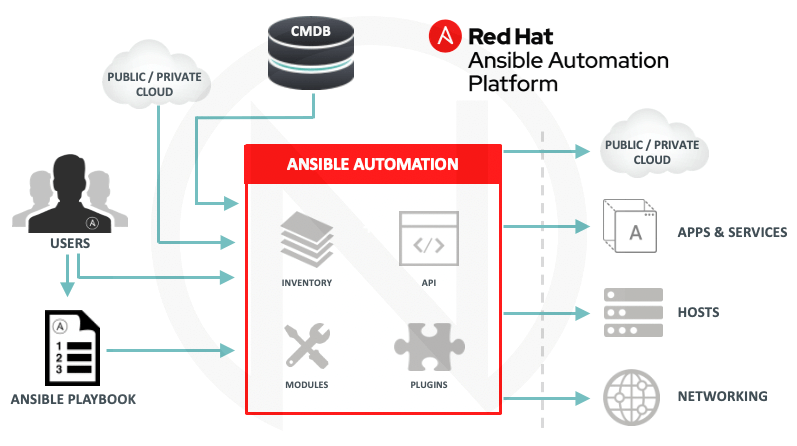
For readers exploring what that looks like in practice, the Ansible Automation Platform overview outlines how centralized automation governance can work across teams.
Where Ansible Fits, From a Business Perspective
In many Public Sector conversations, the transition isn’t from “no automation” to “automation.” It’s from scripts to structure.
Red Hat’s enterprise distribution of Ansible introduces:
- Central control planes
- Role-based access and approval workflows
- Logging and reporting capabilities
- Certified integrations
For organizations that have experimented with open-source tooling but now need accountability and support, this shift can be significant.
For context, Red Hat outlines how enterprise automation differs from community-only tooling in its documentation, but the business case is straightforward: Standardization reduces risk.
Automation as Workforce Multiplier
Public Sector IT staffing isn’t scaling at the same pace as infrastructure demands. Automation, implemented intentionally, becomes a force multiplier:
- Routine tasks become policy-driven workflows
- Patching becomes repeatable
- Baselines can be enforced consistently
- Provisioning timelines shrink
In environments where hiring is constrained and security mandates continue to evolve, that leverage is critical.
The agencies seeing the most benefit aren’t the ones with the most scripts. They’re the ones with the clearest governance.
A Measured Approach
The goal is not to automate everything overnight. I advise my clients to start small with things like:
- Repetitive operational tasks
- Security baseline enforcement
- Compliance-driven configuration checks
Align automation efforts to frameworks already guiding your organization whether that’s NIST, CIS Benchmarks, or internal audit standards.
Final Thought
Public Sector modernization isn’t just about new platforms. It’s about operational discipline.
Automation, when structured and governed properly, becomes one of the most practical tools available to IT leaders.
The question isn’t whether to automate. It’s whether to automate intentionally.

 Mission - Driven Modernization
Leave a comment